Free pilot development bootcamp
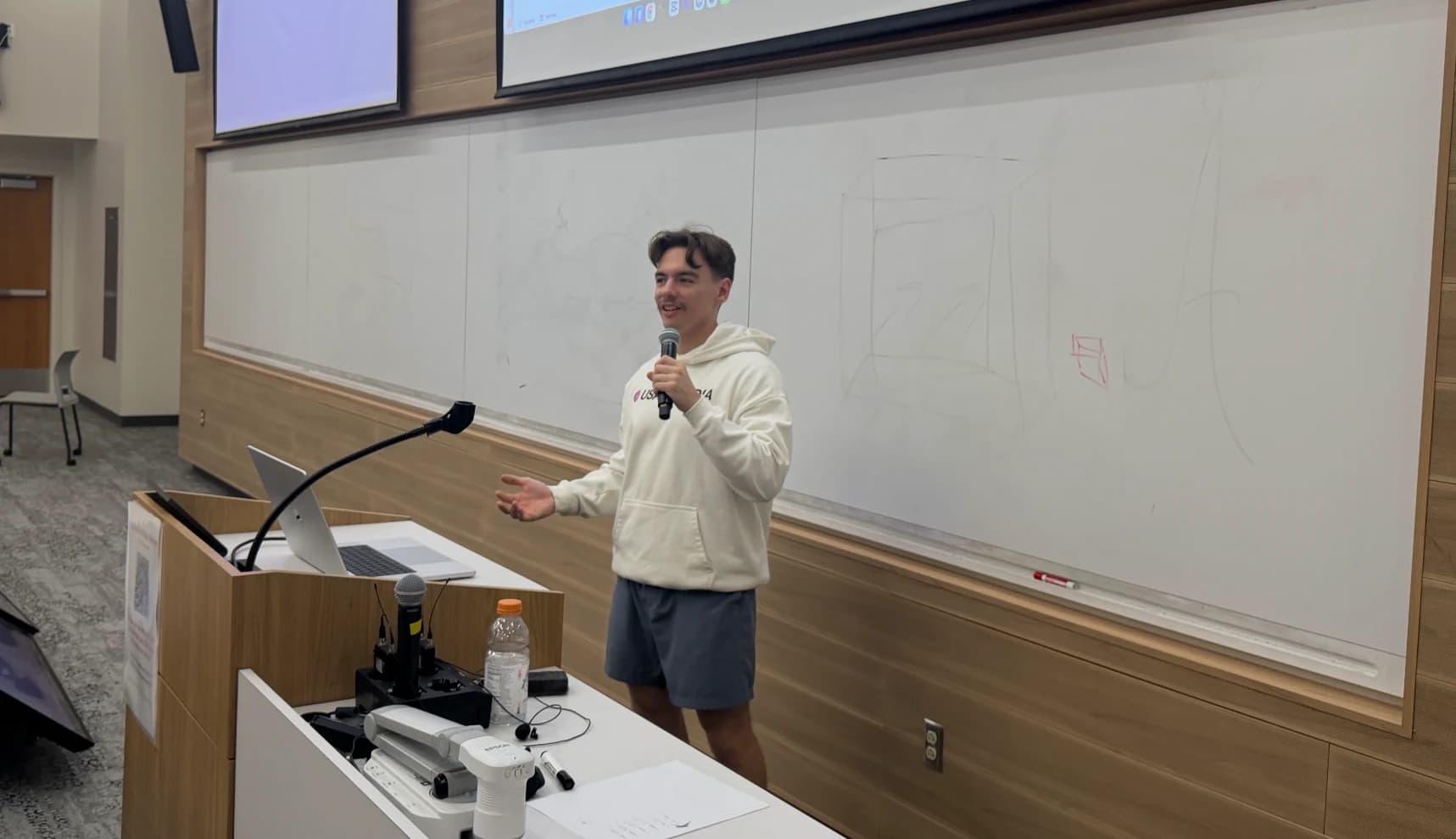
Who is the bootcamp for?
Target organizations include emergency management, construction operations, logistics, manufacturing, medicine, and other professional services.
Problems that are appropriate for the program can genuinely range in type: fragmented software, manual processes that consume too much time, duplicated administrative labor, disconnected data, and general automation opportunities that remain an integral part of scaling goods or services capabilities.
Prerequisites for participation include having a genuine operational problem for which solutions can be tested, having a leadership sponsor, access to relevant employees, and a willingness to evaluate a production implementation.
Applications to the bootcamp are reviewed by our leadership team and accepted selectively.
We offer free discovery, pilot engineering, demonstrations, and the bootcamp. Travel expenses and end-to-end implementation costs are not included in our free delivery offer. Request a bootcamp here.
Have a bootcamp coming up? Start here
Create an account with Usatii if you haven’t already. Once you are registered, you will get a dashboard with all files you may need during the bootcamp process. If you have a developer team, ask them to create an account and our support team will provide them with a private API to test bootcamp functionality within their current stack.
Preparing for your FDE assessment
There are five roles your leadership team must adopt before working with our team of professionals:
| Role | Responsibility |
|---|---|
| Executive sponsor | Sets organizational goals and authorizes cooperation |
| Department representatives | Explain operations, exceptions, and existing workflows |
| IT administrator | Coordinates technical access, APIs, and sandbox environments |
| Security or compliance officer | Approves handling of sensitive systems and information |
| Financial or operations lead | Supplies baseline costs, volumes, and business performance measurements |
If one person must do more than one role, we can advise them accordingly. Please have them reach out to us in advance.
Materials that can be given to our FDEs during bootcamps can include workflow diagrams, existing SOPs, meeting agendas, software inventories, representative documents, historical task volumes, and examples of recurring administrative activity. These are all taken into account when our team builds our initial infrastructure and frames a solution to your most complex problems.
We specifically recommend cross-functional participation during early AI experimentation, and we use customer success planning as a rigorous benchmark pre-deployment as well.
A brief overview of the bootcamp

Usatii’s Forward-Deployed Engineers (FDEs) work on the most complex business problems in the West. Every set of bottlenecks and issues within the various verticals we focus on (emergency management, construction, logistics, manufacturing) are unique. We’ve never seen the same situation twice.
When we begin a free assessment of a company’s workflows, we typically fly or drive our FDEs out to your place of business. While here, FDEs take turns in different departments, observing, taking notes, attending meetings, watching workflows, and learning the alpha of your business. We welcome non-disclosure agreements to avoid conflict. See Protecting your company’s information for more information.
Our FDEs spend up to 2 days in each department for small businesses, 4 days for midsize businesses, and up to 2 weeks for large enterprises (2001+ employees). Their itinerary will be full for up to 60 hours per week, so we encourage you to keep them busy. You can also train them as you might train a new employee in your department, and explain anything that could aid in transitioning your role to them. We welcome you to invite them to board meetings, conference calls, and other administrative events so that they can learn the sales cycle and spot inefficiencies. To learn more about what an FDE collects, see What our engineers look for.
After spending their time in a department, they’ll shift gears and go to another department in your company. If the department doesn’t require their presence, they can be skipped. After the business has been inspected and understood, our FDEs take their notes back home and attend board meetings with our leadership team to form an initial pilot and requirements matrix.
We invite the leadership team to attend our bootcamp the following week, where we take four hours to educate everyone on how the pilot was built, how it was tested, and whether it was an efficiency win.
A successful bootcamp has three attributes:
1. Define a clear problem and blockers
Working with Usatii forces your company to define formal facts about how things operate. This is particularly difficult for companies that don’t spend much time on the administrative aspect of their business. Examples include duplicate data entry, waiting periods, and recurring mistakes.
2. Understand timing
If your work is especially tedious and deals with data handling, this part is most relevant to you. “Time the time that your time is wasted.” In other words, rigorously analyze how many hours of physical capital are expended doing formal tasks the old way. This will serve as a baseline for future comparison, and is helpful when analyzing whether we saved you time in the long run. To take this even further, you can assign a labor rate to each hour of work in the baseline. For example, if doing payroll takes your HR team three hours every week, multiply that by the labor rate for your HR team. If after our pilot, you report saving all labor hours, you can calculate the difference in efficiency with (hours saved per week × fully loaded hourly labor rate × 52 weeks) − (USATII’s FDE implementation fee + first-year software, infrastructure, and maintenance costs). This gives you the projected first-year net economic benefit of the implementation. We also calculate the payback period: how long it would take for the savings to recover your initial investment. Our assessment, pilot development, and bootcamp are free. If the pilot demonstrates measurable value, we prepare a fixed-price proposal covering the forward-deployed engineering, integration, testing, and production deployment required to bring the solution into your business. All ongoing costs are disclosed before an agreement is signed.
3. Learning to operate the solution
Your employees know your business better than anyone. During the bootcamp, we invite the people who perform the affected workflows to use the pilot themselves, working directly with our FDEs to make improvements in the gap between end-of-pilot to beginning-of-work. Our talented team demonstrates how the software processes information, makes decisions, and interacts with your existing systems. By the end, the team should understand how the solution fits into their everyday operations. And as many people are aware, in the software space, it is notoriously difficult to persuade staff to change software. It is a slothy process, and the bottleneck is usually in teaching quality and ease-of-handoff. To make the handoff easier, leadership must be ready to be incredibly transparent and understandable of employee concerns. We provide organizational change management and employee adoption playbooks to help leadership prepare staff, address concerns, and facilitate a smooth transition to new software.
Protecting your company’s information
The FDE model genuinely gives Usatii unusually deep access to your organization’s data. But access is controlled through a legally and operationally robust framework.
Usatii is committed to protecting the privacy and security of customer data. The protection and responsible processing of customer information are an integral part of our operations framework and are built first-class into our products and services.
Generative AI technologies, including large language models (LLMs), have the potential to transform business operations, improve efficiency, and support informed decision-making. However, their adoption introduces important considerations surrounding data privacy, security, algorithmic bias, discrimination, and human oversight. At Usatii, we recognize the importance of addressing these challenges. This page answers frequently asked questions about our approach to AI security, privacy, and responsible implementation.
Is Usatii AI protected by the same security measures as data in other enterprise products?
Yes. Usatii AI incorporates all of Usatii’s advanced security measures for the protection of sensitive data and in compliance with industry standards and regulations. We provide robust role-based access controls, advanced encryption, and verbose audit capabilities to maintain the utmost data integrity and transparency available in a frontier AI system. Besides simply crossing off the regulatory checkmark, governance tools available within our platforms help organizations maintain accountability and a historical lineage within AI and software operations.
Where are Usatii AI third-party-hosted models provided from?
When integrating with third-party-hosted models, Usatii AI is instructed and designed to take advantage of regional endpoints where possible. This minimizes latency and is currently supported in the US, UK, EU, and MENA for select models.
Does the service result in storage of any customer data by a third-party-hosted model service provider?
No. Confidently, the team does not store data from prompts or completions within a private siloed repository that other companies can access. This is a first-class issue for us and we maintain zero-data retention (ZDR) policies where possible. Read more about ZDR here.
Is customer data being used to train models?
No. When Usatii accesses third-party-hosted model services, no customer data is used to retrain such models. We secure strict technical and contractual guarantees from third-party hosted model service providers to ensure that no customer data submitted to these models is used for any type of training. If customers desire the retraining of their own private AI model deployments, we can facilitate this governed system for select deployments.
What our engineers look for
FDEs observe five different dimensions during discovery:
- Workflow structure: how information, tasks, approvals, and responsibilities move through the organization.
- Data infrastructure: where critical information lives, how it is transferred, and where systems fail to communicate.
- Operational inefficiencies: manual reconciliation, duplicate entry, waiting periods, processing delays, and recurring mistakes.
- Business logic: undocumented decisions, exceptions, and industry-specific practices that employees rely on.
- Automation opportunities: processes that could be accelerated, consolidated, automated, or otherwise supported by an artificial intelligence integration of some kind.
These sensitive dimensions are referred to by the team as alpha. In other words, anything that could give the organization an edge is fair game for our team to observe, so long as the requisite agreements are in place beforehand to avoid overreach.
Selecting the first pilot
Pilot selection is a structured 60-90 minute process between Usatii’s FDEs and leadership, along with the customer’s leadership and a small handful of their affected employees. This occurs immediately after the departmental discovery phase. Of all the problems Usatii discovered, which one should we solve first to demonstrate the greatest measurable business value within the constraints of a free pilot? That is the question we ask time and time again.
Imagine we’ve spent a week studying a midsize construction company. Our team identified three potential projects:
| Opportunity | Business impact | Technical feasibility | Data readiness | Operational risk |
|---|---|---|---|---|
| Automate incoming RFQs and estimator assignments | High | High | High | Low |
| Coordinate crew scheduling across active projects | Very high | Medium | Medium | Medium |
| Automate construction bid pricing | Very high | Low | Medium | High |
During the selection meeting, Usatii presents each opportunity to the customer's executive sponsor and relevant department heads. Assume we select RFQ intake automation for the initial pilot.
It has several advantages:
- It involves repetitive, measurable administrative work.
- Historical documents can be used to test the automation.
- The pilot can demonstrate meaningful value without controlling sensitive financial decisions.
- It can be developed with a potentially short engineering window.
- It provides a foundation for expanding into estimating, procurement, and broader construction operations.
The other opportunities aren’t discarded – we place them into a longer-term roadmap for our end-to-end phase. This is commonly called the Expand phase.
Importantly, we don’t let a high business-impact score override serious security, legal, or operational concerns. Some projects should be ruled out as free pilots regardless of their commercial potential.
After this, a formal Pilot Charter is created that dictates any relevant details as we embark on our free proof-of-value delivery. Using our previous example:
Pilot Charter
| Field | Description |
|---|---|
| Project | RFQ Intake Automation |
| Customer | Hypothetical midsize construction company |
| Department | Estimating |
| Business owner | Director of Estimating |
| Problem | Incoming RFQs require employees to review documents, extract project information, and manually assign work to estimators. |
| Current performance | Approximately 90 RFQs weekly, averaging 20 minutes of administrative handling each |
| Proposed solution | Automatically extract RFQ information, organize attachments, and recommend estimator assignments |
| Data requirements | 100 representative historical RFQs approved for testing |
| Systems involved | Email, document storage, estimating software |
| Pilot scope | RFQ classification, data extraction, document organization, and assignment recommendations |
| Exclusions | Automated bid pricing, customer communications, and changes to live production records |
| Performance target | At least 60% reduction in average administrative handling time |
| Quality target | At least 95% accuracy on agreed critical data fields, with human review for uncertain results |
| Customer responsibilities | Provide test documents, answer workflow questions, and participate in testing |
| USATII responsibilities | Develop, test, demonstrate, and document the proposed automation |
| Acceptance | Both parties review the results against the agreed success criteria at the bootcamp |
A measurable target must be added to the build. For example, there might be a 60% reduction in processing time, or 12 hours of administrative processing weekly, or even 18 hours of recovered employee capacity per week. That is potentially 936 hours annually – and you just got it back for free.
At a hypothetical labor rate of $45 per hour, the recovered capacity represents approximately $42,120 in annual labor value recovered from a free pilot. Of course, the customer hasn’t necessarily recovered this much from the free pilot – we demonstrate potential savings.